Data & AI Governance Insights
Practical insights on AI governance, responsible AI, regulations, and building trustworthy AI systems.

AI governance jobs grew 234%. The profession now has to mature just as fast.
In 2025, the AI Workforce Consortium report provided some encouraging news for career seekers. It also warns organizations that AI adoption is moving faster than the governance capability needed to direct it.
AI governance professionals have been explaining why oversight matters. Now, the labor market is answering with numbers.
In the ICT in Motion: The Next Wave of AI Integration full report, demand for the AI Risk & Governance Specialist role increased by 234% across G7 economies.
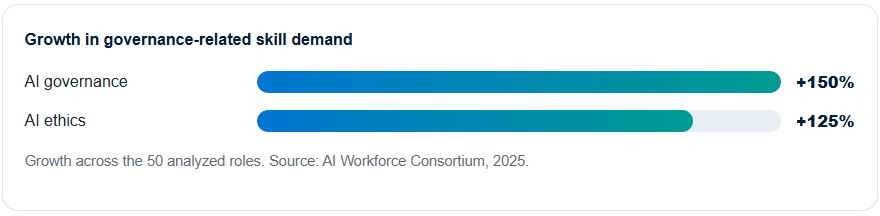
Demand for AI governance skills rose 150%, while AI ethics skills rose 125%.
Those figures don't just validate AI governance as a career category. They also reveal a capability gap. Organizations are deploying increasingly autonomous and interconnected systems, yet they still need people who can translate broad principles into decisions, controls, evidence, escalation routes, and accountable ownership.

What the report actually measured
The Consortium, whose members include Accenture, Cisco, Cornerstone, Eightfold, Google, IBM, Indeed, Intel, Microsoft, and SAP, analyzed job-posting demand across the G7. It compared July 2024 through June 2025 with July 2023 through June 2024. The selected roles were those members considered important to their AI workforce strategies and priorities for reskilling or upskilling.
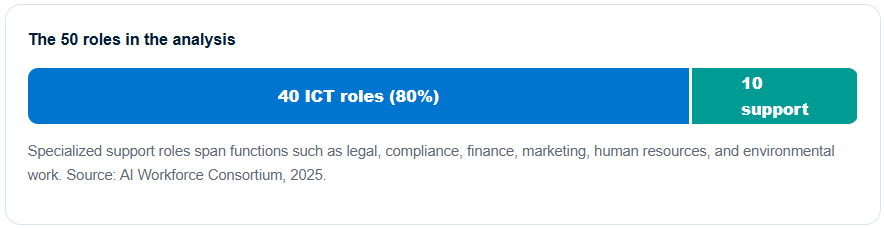
The report defines significant AI-skills integration as AI-related skills or tools appearing in more than 10% of postings for a role. On that basis, 78% of the 50 roles, equivalent to 39 roles, crossed the threshold. That is a useful signal of diffusion, but it should not be misread as saying that 78% of every job is now AI work.
AI governance is becoming a distributed organizational capability. When AI skills spread through technology and support functions, governance has to spread with them while retaining clear authority and escalation.
The fastest-growing roles reveal two parallel demands
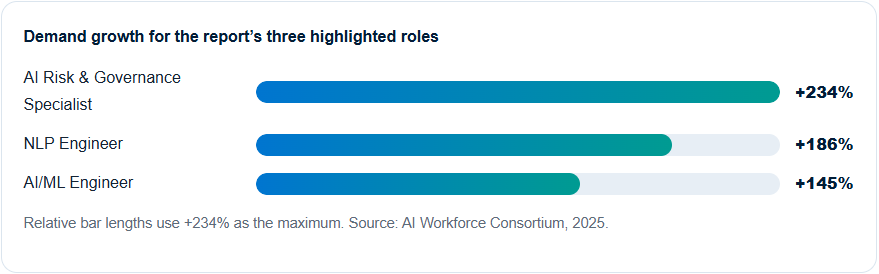
The role data shows that organizations are building AI and simultaneously building the capacity to govern it. AI/ML Engineer demand increased 145%; NLP Engineer demand increased 186%; and AI Risk & Governance Specialist demand increased 234%.
Governance does not seem to be trailing engineering in this comparison. It is the fastest-growing of the three highlighted roles.
That doesn't mean governance professionals should try to become machine-learning engineers. On the contrary, it means they must be technically conversant enough to ask consequential questions: What can the system do? Where can it act? What data, tools, and agents can it reach? What happens when it fails? Which evidence demonstrates that the stated control actually operates?
Agentic AI is changing the skills profile
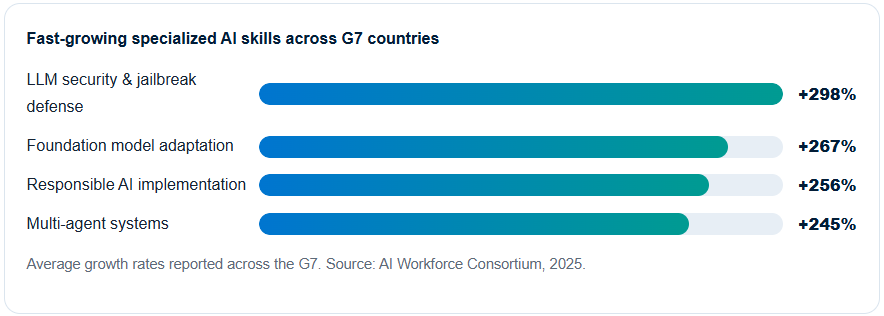
The strongest growth is clustered around security, adaptation, responsible implementation, and multi-agent architectures.
LLM security and jailbreak defense grew 298%;
Foundation model adaptation 267%;
Responsible AI implementation 256%;
Multi-agent systems 245%.
This combination is important. Agentic AI moves governance beyond approving a static model. Governance professionals must be able to define permissions, human intervention points, tool-use boundaries, monitoring, identity and access controls, incident response, and safe shutdown behavior.
A policy that says “humans remain accountable” becomes inadequate unless the operating model identifies which human has decision rights, what evidence that person receives, and when the system must stop.
Governance and ethics are growing, but implementation is the differentiator
The profession should welcome these numbers without becoming complacent.
“Governance” can still be used as a broad label for policy, compliance, risk, assurance, ethics, or program management. Employers ultimately need outputs they can use: an AI inventory, impact assessment, risk register, model or system card, control map, validation report, exception process, monitoring plan, audit trail, and evidence of sign-off.
The report identifies high-severity shortages in large language models, prompt engineering, generative AI, AI ethics, and AI security. For governance professionals, the answer is not to collect disconnected credentials. It is to build a T-shaped capability: depth in governance and risk, combined with working literacy in AI systems, data, security, and the organization’s business context.
Market signal | What it means for AI governance practice |
|---|---|
AI Risk & Governance Specialist: +234% | Organizations need dedicated ownership, but titles and scope will vary. Search by responsibilities as well as job title. |
Responsible AI implementation: +256% | Principles must become workflows, controls, evidence, and decision rights. |
LLM security and jailbreak defense: +298% | Governance and cybersecurity must share scenarios, controls, incidents, and accountability. |
Multi-agent systems: +245% | Assess autonomy, tool access, cascading actions, observability, and human intervention. |
Human skills remain priorities | Communication, collaboration, leadership, critical thinking, and problem solving are control-enabling capabilities, not decorative soft skills. |
The human-skills finding is a governance finding
The report highlights communication, collaboration, leadership, critical thinking, and problem solving as continuing priorities. In AI governance, these skills directly affect whether controls work. A technically correct risk assessment fails if its author cannot elicit information from developers, challenge assumptions, communicate uncertainty to executives, or negotiate remediation with product owners.
This conclusion aligns with broader evidence.
The World Economic Forum’s Future of Jobs Report 2025, based on more than 1,000 employers representing over 14 million workers, treats technological and human capabilities as intertwined workforce priorities.
The International Labour Organization’s 2025 global GenAI exposure study finds that job transformation is more likely than complete replacement because most occupations still contain tasks requiring human input.
The OECD’s analysis of AI and changing skill demand adds longer-run labor-market context.
A warning about entry-level pathways
A portion of the report states that more than 90% of entry-level roles are exposed to AI-driven change. The concern is credible. If AI absorbs some routine tasks through which early-career workers once learned, organizations must intentionally redesign developmental work.
For AI governance teams, that means creating supervised pathways in which junior professionals can conduct inventory interviews, map requirements, document controls, test evidence, support impact assessments, and analyze incidents. Entry-level work should not disappear. It should become more structured, evidence-oriented, and developmental.
What AI governance leaders should do now
Define capability before headcount. Map the governance decisions, artifacts, controls, and assurance activities the organization needs. Then determine which roles own, execute, advise, or challenge them.
Connect workforce planning to the AI inventory. Training priorities should follow the systems, autonomy levels, use cases, and risk exposures actually entering the organization.
Build cross-functional practice, not awareness alone. Use scenario exercises that bring legal, security, privacy, data, product, audit, and business owners together around a real AI use case.
Assess evidence-producing competence. Ask whether employees can complete an impact assessment, write a defensible risk statement, map a control, document an exception, and explain residual risk.
Prepare for agentic governance. Extend existing methods to cover permissions, tools, memory, chained actions, agent-to-agent interactions, observability, and intervention.
Use recognized frameworks as operating anchors. The NIST AI Risk Management Framework offers a practical structure for governing, mapping, measuring, and managing AI risk. Organizations operating in or serving Europe should also map workforce capability to applicable EU AI Act obligations.
My conclusion. Opportunities Abound. But the bar is rising
The report’s most important number is not simply 234%. It's the distance between rising demand and organizational readiness. The market is asking for governance specialists at the same time that the underlying technology is becoming more autonomous, security-sensitive, and embedded across functions.
For professionals, this is a strong career signal. For employers, it is a design challenge. The winning AI governance function will not be the one with the longest policy. It will be the one that can help the organization move with justified confidence: translating risk into decisions, decisions into controls, and controls into credible evidence.
Read the source: Full 2025 report | Executive summary | AI Workforce Consortium resource hub
Sources and further reading
AI Workforce Consortium. ICT in Motion: The Next Wave of AI Integration (2025), full report.
AI Workforce Consortium. Executive summary (2025).
World Economic Forum. The Future of Jobs Report 2025.
International Labour Organization. Generative AI and Jobs: A Refined Global Index of Occupational Exposure (2025).
OECD. Artificial Intelligence and the Changing Demand for Skills in the Labour Market.
NIST. AI Risk Management Framework.
Analysis note: Unless otherwise stated, statistics above come from the 2025 executive summary. Growth denotes changes in job-posting demand or skill demand in the report’s G7 analysis. The comparison period is July 2024-June 2025 versus July 2023-June 2024.

AI governance jobs grew 234%. The profession now has to mature just as fast.
In 2025, the AI Workforce Consortium report provided some encouraging news for career seekers. It also warns organizations that AI adoption is moving faster than the governance capability needed to direct it.
AI governance professionals have been explaining why oversight matters. Now, the labor market is answering with numbers.
In the ICT in Motion: The Next Wave of AI Integration full report, demand for the AI Risk & Governance Specialist role increased by 234% across G7 economies.
Demand for AI governance skills rose 150%, while AI ethics skills rose 125%.
Those figures don't just validate AI governance as a career category. They also reveal a capability gap. Organizations are deploying increasingly autonomous and interconnected systems, yet they still need people who can translate broad principles into decisions, controls, evidence, escalation routes, and accountable ownership.
What the report actually measured
The Consortium, whose members include Accenture, Cisco, Cornerstone, Eightfold, Google, IBM, Indeed, Intel, Microsoft, and SAP, analyzed job-posting demand across the G7. It compared July 2024 through June 2025 with July 2023 through June 2024. The selected roles were those members considered important to their AI workforce strategies and priorities for reskilling or upskilling.
The report defines significant AI-skills integration as AI-related skills or tools appearing in more than 10% of postings for a role. On that basis, 78% of the 50 roles, equivalent to 39 roles, crossed the threshold. That is a useful signal of diffusion, but it should not be misread as saying that 78% of every job is now AI work.
AI governance is becoming a distributed organizational capability. When AI skills spread through technology and support functions, governance has to spread with them while retaining clear authority and escalation.
The fastest-growing roles reveal two parallel demands
The role data shows that organizations are building AI and simultaneously building the capacity to govern it. AI/ML Engineer demand increased 145%; NLP Engineer demand increased 186%; and AI Risk & Governance Specialist demand increased 234%.
Governance does not seem to be trailing engineering in this comparison. It is the fastest-growing of the three highlighted roles.
That doesn't mean governance professionals should try to become machine-learning engineers. On the contrary, it means they must be technically conversant enough to ask consequential questions: What can the system do? Where can it act? What data, tools, and agents can it reach? What happens when it fails? Which evidence demonstrates that the stated control actually operates?
Agentic AI is changing the skills profile
The strongest growth is clustered around security, adaptation, responsible implementation, and multi-agent architectures.
LLM security and jailbreak defense grew 298%;
Foundation model adaptation 267%;
Responsible AI implementation 256%;
Multi-agent systems 245%.
This combination is important. Agentic AI moves governance beyond approving a static model. Governance professionals must be able to define permissions, human intervention points, tool-use boundaries, monitoring, identity and access controls, incident response, and safe shutdown behavior.
A policy that says “humans remain accountable” becomes inadequate unless the operating model identifies which human has decision rights, what evidence that person receives, and when the system must stop.
Governance and ethics are growing, but implementation is the differentiator
The profession should welcome these numbers without becoming complacent.
“Governance” can still be used as a broad label for policy, compliance, risk, assurance, ethics, or program management. Employers ultimately need outputs they can use: an AI inventory, impact assessment, risk register, model or system card, control map, validation report, exception process, monitoring plan, audit trail, and evidence of sign-off.
The report identifies high-severity shortages in large language models, prompt engineering, generative AI, AI ethics, and AI security. For governance professionals, the answer is not to collect disconnected credentials. It is to build a T-shaped capability: depth in governance and risk, combined with working literacy in AI systems, data, security, and the organization’s business context.
Market signal | What it means for AI governance practice |
|---|---|
AI Risk & Governance Specialist: +234% | Organizations need dedicated ownership, but titles and scope will vary. Search by responsibilities as well as job title. |
Responsible AI implementation: +256% | Principles must become workflows, controls, evidence, and decision rights. |
LLM security and jailbreak defense: +298% | Governance and cybersecurity must share scenarios, controls, incidents, and accountability. |
Multi-agent systems: +245% | Assess autonomy, tool access, cascading actions, observability, and human intervention. |
Human skills remain priorities | Communication, collaboration, leadership, critical thinking, and problem solving are control-enabling capabilities, not decorative soft skills. |
The human-skills finding is a governance finding
The report highlights communication, collaboration, leadership, critical thinking, and problem solving as continuing priorities. In AI governance, these skills directly affect whether controls work. A technically correct risk assessment fails if its author cannot elicit information from developers, challenge assumptions, communicate uncertainty to executives, or negotiate remediation with product owners.
This conclusion aligns with broader evidence.
The World Economic Forum’s Future of Jobs Report 2025, based on more than 1,000 employers representing over 14 million workers, treats technological and human capabilities as intertwined workforce priorities.
The International Labour Organization’s 2025 global GenAI exposure study finds that job transformation is more likely than complete replacement because most occupations still contain tasks requiring human input.
The OECD’s analysis of AI and changing skill demand adds longer-run labor-market context.
A warning about entry-level pathways
A portion of the report states that more than 90% of entry-level roles are exposed to AI-driven change. The concern is credible. If AI absorbs some routine tasks through which early-career workers once learned, organizations must intentionally redesign developmental work.
For AI governance teams, that means creating supervised pathways in which junior professionals can conduct inventory interviews, map requirements, document controls, test evidence, support impact assessments, and analyze incidents. Entry-level work should not disappear. It should become more structured, evidence-oriented, and developmental.
What AI governance leaders should do now
Define capability before headcount. Map the governance decisions, artifacts, controls, and assurance activities the organization needs. Then determine which roles own, execute, advise, or challenge them.
Connect workforce planning to the AI inventory. Training priorities should follow the systems, autonomy levels, use cases, and risk exposures actually entering the organization.
Build cross-functional practice, not awareness alone. Use scenario exercises that bring legal, security, privacy, data, product, audit, and business owners together around a real AI use case.
Assess evidence-producing competence. Ask whether employees can complete an impact assessment, write a defensible risk statement, map a control, document an exception, and explain residual risk.
Prepare for agentic governance. Extend existing methods to cover permissions, tools, memory, chained actions, agent-to-agent interactions, observability, and intervention.
Use recognized frameworks as operating anchors. The NIST AI Risk Management Framework offers a practical structure for governing, mapping, measuring, and managing AI risk. Organizations operating in or serving Europe should also map workforce capability to applicable EU AI Act obligations.
My conclusion. Opportunities Abound. But the bar is rising
The report’s most important number is not simply 234%. It's the distance between rising demand and organizational readiness. The market is asking for governance specialists at the same time that the underlying technology is becoming more autonomous, security-sensitive, and embedded across functions.
For professionals, this is a strong career signal. For employers, it is a design challenge. The winning AI governance function will not be the one with the longest policy. It will be the one that can help the organization move with justified confidence: translating risk into decisions, decisions into controls, and controls into credible evidence.
Read the source: Full 2025 report | Executive summary | AI Workforce Consortium resource hub
Sources and further reading
AI Workforce Consortium. ICT in Motion: The Next Wave of AI Integration (2025), full report.
AI Workforce Consortium. Executive summary (2025).
World Economic Forum. The Future of Jobs Report 2025.
International Labour Organization. Generative AI and Jobs: A Refined Global Index of Occupational Exposure (2025).
OECD. Artificial Intelligence and the Changing Demand for Skills in the Labour Market.
NIST. AI Risk Management Framework.
Analysis note: Unless otherwise stated, statistics above come from the 2025 executive summary. Growth denotes changes in job-posting demand or skill demand in the report’s G7 analysis. The comparison period is July 2024-June 2025 versus July 2023-June 2024.
AI governance jobs grew 234%. The profession now has to mature just as fast.
In 2025, the AI Workforce Consortium report provided some encouraging news for career seekers. It also warns organizations that AI adoption is moving faster than the governance capability needed to direct it.
AI governance professionals have been explaining why oversight matters. Now, the labor market is answering with numbers.
In the ICT in Motion: The Next Wave of AI Integration full report, demand for the AI Risk & Governance Specialist role increased by 234% across G7 economies.
Demand for AI governance skills rose 150%, while AI ethics skills rose 125%.
Those figures don't just validate AI governance as a career category. They also reveal a capability gap. Organizations are deploying increasingly autonomous and interconnected systems, yet they still need people who can translate broad principles into decisions, controls, evidence, escalation routes, and accountable ownership.
What the report actually measured
The Consortium, whose members include Accenture, Cisco, Cornerstone, Eightfold, Google, IBM, Indeed, Intel, Microsoft, and SAP, analyzed job-posting demand across the G7. It compared July 2024 through June 2025 with July 2023 through June 2024. The selected roles were those members considered important to their AI workforce strategies and priorities for reskilling or upskilling.
The report defines significant AI-skills integration as AI-related skills or tools appearing in more than 10% of postings for a role. On that basis, 78% of the 50 roles, equivalent to 39 roles, crossed the threshold. That is a useful signal of diffusion, but it should not be misread as saying that 78% of every job is now AI work.
AI governance is becoming a distributed organizational capability. When AI skills spread through technology and support functions, governance has to spread with them while retaining clear authority and escalation.
The fastest-growing roles reveal two parallel demands
The role data shows that organizations are building AI and simultaneously building the capacity to govern it. AI/ML Engineer demand increased 145%; NLP Engineer demand increased 186%; and AI Risk & Governance Specialist demand increased 234%.
Governance does not seem to be trailing engineering in this comparison. It is the fastest-growing of the three highlighted roles.
That doesn't mean governance professionals should try to become machine-learning engineers. On the contrary, it means they must be technically conversant enough to ask consequential questions: What can the system do? Where can it act? What data, tools, and agents can it reach? What happens when it fails? Which evidence demonstrates that the stated control actually operates?
Agentic AI is changing the skills profile
The strongest growth is clustered around security, adaptation, responsible implementation, and multi-agent architectures.
LLM security and jailbreak defense grew 298%;
Foundation model adaptation 267%;
Responsible AI implementation 256%;
Multi-agent systems 245%.
This combination is important. Agentic AI moves governance beyond approving a static model. Governance professionals must be able to define permissions, human intervention points, tool-use boundaries, monitoring, identity and access controls, incident response, and safe shutdown behavior.
A policy that says “humans remain accountable” becomes inadequate unless the operating model identifies which human has decision rights, what evidence that person receives, and when the system must stop.
Governance and ethics are growing, but implementation is the differentiator
The profession should welcome these numbers without becoming complacent.
“Governance” can still be used as a broad label for policy, compliance, risk, assurance, ethics, or program management. Employers ultimately need outputs they can use: an AI inventory, impact assessment, risk register, model or system card, control map, validation report, exception process, monitoring plan, audit trail, and evidence of sign-off.
The report identifies high-severity shortages in large language models, prompt engineering, generative AI, AI ethics, and AI security. For governance professionals, the answer is not to collect disconnected credentials. It is to build a T-shaped capability: depth in governance and risk, combined with working literacy in AI systems, data, security, and the organization’s business context.
Market signal | What it means for AI governance practice |
|---|---|
AI Risk & Governance Specialist: +234% | Organizations need dedicated ownership, but titles and scope will vary. Search by responsibilities as well as job title. |
Responsible AI implementation: +256% | Principles must become workflows, controls, evidence, and decision rights. |
LLM security and jailbreak defense: +298% | Governance and cybersecurity must share scenarios, controls, incidents, and accountability. |
Multi-agent systems: +245% | Assess autonomy, tool access, cascading actions, observability, and human intervention. |
Human skills remain priorities | Communication, collaboration, leadership, critical thinking, and problem solving are control-enabling capabilities, not decorative soft skills. |
The human-skills finding is a governance finding
The report highlights communication, collaboration, leadership, critical thinking, and problem solving as continuing priorities. In AI governance, these skills directly affect whether controls work. A technically correct risk assessment fails if its author cannot elicit information from developers, challenge assumptions, communicate uncertainty to executives, or negotiate remediation with product owners.
This conclusion aligns with broader evidence.
The World Economic Forum’s Future of Jobs Report 2025, based on more than 1,000 employers representing over 14 million workers, treats technological and human capabilities as intertwined workforce priorities.
The International Labour Organization’s 2025 global GenAI exposure study finds that job transformation is more likely than complete replacement because most occupations still contain tasks requiring human input.
The OECD’s analysis of AI and changing skill demand adds longer-run labor-market context.
A warning about entry-level pathways
A portion of the report states that more than 90% of entry-level roles are exposed to AI-driven change. The concern is credible. If AI absorbs some routine tasks through which early-career workers once learned, organizations must intentionally redesign developmental work.
For AI governance teams, that means creating supervised pathways in which junior professionals can conduct inventory interviews, map requirements, document controls, test evidence, support impact assessments, and analyze incidents. Entry-level work should not disappear. It should become more structured, evidence-oriented, and developmental.
What AI governance leaders should do now
Define capability before headcount. Map the governance decisions, artifacts, controls, and assurance activities the organization needs. Then determine which roles own, execute, advise, or challenge them.
Connect workforce planning to the AI inventory. Training priorities should follow the systems, autonomy levels, use cases, and risk exposures actually entering the organization.
Build cross-functional practice, not awareness alone. Use scenario exercises that bring legal, security, privacy, data, product, audit, and business owners together around a real AI use case.
Assess evidence-producing competence. Ask whether employees can complete an impact assessment, write a defensible risk statement, map a control, document an exception, and explain residual risk.
Prepare for agentic governance. Extend existing methods to cover permissions, tools, memory, chained actions, agent-to-agent interactions, observability, and intervention.
Use recognized frameworks as operating anchors. The NIST AI Risk Management Framework offers a practical structure for governing, mapping, measuring, and managing AI risk. Organizations operating in or serving Europe should also map workforce capability to applicable EU AI Act obligations.
My conclusion. Opportunities Abound. But the bar is rising
The report’s most important number is not simply 234%. It's the distance between rising demand and organizational readiness. The market is asking for governance specialists at the same time that the underlying technology is becoming more autonomous, security-sensitive, and embedded across functions.
For professionals, this is a strong career signal. For employers, it is a design challenge. The winning AI governance function will not be the one with the longest policy. It will be the one that can help the organization move with justified confidence: translating risk into decisions, decisions into controls, and controls into credible evidence.
Read the source: Full 2025 report | Executive summary | AI Workforce Consortium resource hub
Sources and further reading
AI Workforce Consortium. ICT in Motion: The Next Wave of AI Integration (2025), full report.
AI Workforce Consortium. Executive summary (2025).
World Economic Forum. The Future of Jobs Report 2025.
International Labour Organization. Generative AI and Jobs: A Refined Global Index of Occupational Exposure (2025).
OECD. Artificial Intelligence and the Changing Demand for Skills in the Labour Market.
NIST. AI Risk Management Framework.
Analysis note: Unless otherwise stated, statistics above come from the 2025 executive summary. Growth denotes changes in job-posting demand or skill demand in the report’s G7 analysis. The comparison period is July 2024-June 2025 versus July 2023-June 2024.
AI governance jobs grew 234%. The profession now has to mature just as fast.
In 2025, the AI Workforce Consortium report provided some encouraging news for career seekers. It also warns organizations that AI adoption is moving faster than the governance capability needed to direct it.
AI governance professionals have been explaining why oversight matters. Now, the labor market is answering with numbers.
In the ICT in Motion: The Next Wave of AI Integration full report, demand for the AI Risk & Governance Specialist role increased by 234% across G7 economies.
Demand for AI governance skills rose 150%, while AI ethics skills rose 125%.
Those figures don't just validate AI governance as a career category. They also reveal a capability gap. Organizations are deploying increasingly autonomous and interconnected systems, yet they still need people who can translate broad principles into decisions, controls, evidence, escalation routes, and accountable ownership.
What the report actually measured
The Consortium, whose members include Accenture, Cisco, Cornerstone, Eightfold, Google, IBM, Indeed, Intel, Microsoft, and SAP, analyzed job-posting demand across the G7. It compared July 2024 through June 2025 with July 2023 through June 2024. The selected roles were those members considered important to their AI workforce strategies and priorities for reskilling or upskilling.
The report defines significant AI-skills integration as AI-related skills or tools appearing in more than 10% of postings for a role. On that basis, 78% of the 50 roles, equivalent to 39 roles, crossed the threshold. That is a useful signal of diffusion, but it should not be misread as saying that 78% of every job is now AI work.
AI governance is becoming a distributed organizational capability. When AI skills spread through technology and support functions, governance has to spread with them while retaining clear authority and escalation.
The fastest-growing roles reveal two parallel demands
The role data shows that organizations are building AI and simultaneously building the capacity to govern it. AI/ML Engineer demand increased 145%; NLP Engineer demand increased 186%; and AI Risk & Governance Specialist demand increased 234%.
Governance does not seem to be trailing engineering in this comparison. It is the fastest-growing of the three highlighted roles.
That doesn't mean governance professionals should try to become machine-learning engineers. On the contrary, it means they must be technically conversant enough to ask consequential questions: What can the system do? Where can it act? What data, tools, and agents can it reach? What happens when it fails? Which evidence demonstrates that the stated control actually operates?
Agentic AI is changing the skills profile
The strongest growth is clustered around security, adaptation, responsible implementation, and multi-agent architectures.
LLM security and jailbreak defense grew 298%;
Foundation model adaptation 267%;
Responsible AI implementation 256%;
Multi-agent systems 245%.
This combination is important. Agentic AI moves governance beyond approving a static model. Governance professionals must be able to define permissions, human intervention points, tool-use boundaries, monitoring, identity and access controls, incident response, and safe shutdown behavior.
A policy that says “humans remain accountable” becomes inadequate unless the operating model identifies which human has decision rights, what evidence that person receives, and when the system must stop.
Governance and ethics are growing, but implementation is the differentiator
The profession should welcome these numbers without becoming complacent.
“Governance” can still be used as a broad label for policy, compliance, risk, assurance, ethics, or program management. Employers ultimately need outputs they can use: an AI inventory, impact assessment, risk register, model or system card, control map, validation report, exception process, monitoring plan, audit trail, and evidence of sign-off.
The report identifies high-severity shortages in large language models, prompt engineering, generative AI, AI ethics, and AI security. For governance professionals, the answer is not to collect disconnected credentials. It is to build a T-shaped capability: depth in governance and risk, combined with working literacy in AI systems, data, security, and the organization’s business context.
Market signal | What it means for AI governance practice |
|---|---|
AI Risk & Governance Specialist: +234% | Organizations need dedicated ownership, but titles and scope will vary. Search by responsibilities as well as job title. |
Responsible AI implementation: +256% | Principles must become workflows, controls, evidence, and decision rights. |
LLM security and jailbreak defense: +298% | Governance and cybersecurity must share scenarios, controls, incidents, and accountability. |
Multi-agent systems: +245% | Assess autonomy, tool access, cascading actions, observability, and human intervention. |
Human skills remain priorities | Communication, collaboration, leadership, critical thinking, and problem solving are control-enabling capabilities, not decorative soft skills. |
The human-skills finding is a governance finding
The report highlights communication, collaboration, leadership, critical thinking, and problem solving as continuing priorities. In AI governance, these skills directly affect whether controls work. A technically correct risk assessment fails if its author cannot elicit information from developers, challenge assumptions, communicate uncertainty to executives, or negotiate remediation with product owners.
This conclusion aligns with broader evidence.
The World Economic Forum’s Future of Jobs Report 2025, based on more than 1,000 employers representing over 14 million workers, treats technological and human capabilities as intertwined workforce priorities.
The International Labour Organization’s 2025 global GenAI exposure study finds that job transformation is more likely than complete replacement because most occupations still contain tasks requiring human input.
The OECD’s analysis of AI and changing skill demand adds longer-run labor-market context.
A warning about entry-level pathways
A portion of the report states that more than 90% of entry-level roles are exposed to AI-driven change. The concern is credible. If AI absorbs some routine tasks through which early-career workers once learned, organizations must intentionally redesign developmental work.
For AI governance teams, that means creating supervised pathways in which junior professionals can conduct inventory interviews, map requirements, document controls, test evidence, support impact assessments, and analyze incidents. Entry-level work should not disappear. It should become more structured, evidence-oriented, and developmental.
What AI governance leaders should do now
Define capability before headcount. Map the governance decisions, artifacts, controls, and assurance activities the organization needs. Then determine which roles own, execute, advise, or challenge them.
Connect workforce planning to the AI inventory. Training priorities should follow the systems, autonomy levels, use cases, and risk exposures actually entering the organization.
Build cross-functional practice, not awareness alone. Use scenario exercises that bring legal, security, privacy, data, product, audit, and business owners together around a real AI use case.
Assess evidence-producing competence. Ask whether employees can complete an impact assessment, write a defensible risk statement, map a control, document an exception, and explain residual risk.
Prepare for agentic governance. Extend existing methods to cover permissions, tools, memory, chained actions, agent-to-agent interactions, observability, and intervention.
Use recognized frameworks as operating anchors. The NIST AI Risk Management Framework offers a practical structure for governing, mapping, measuring, and managing AI risk. Organizations operating in or serving Europe should also map workforce capability to applicable EU AI Act obligations.
My conclusion. Opportunities Abound. But the bar is rising
The report’s most important number is not simply 234%. It's the distance between rising demand and organizational readiness. The market is asking for governance specialists at the same time that the underlying technology is becoming more autonomous, security-sensitive, and embedded across functions.
For professionals, this is a strong career signal. For employers, it is a design challenge. The winning AI governance function will not be the one with the longest policy. It will be the one that can help the organization move with justified confidence: translating risk into decisions, decisions into controls, and controls into credible evidence.
Read the source: Full 2025 report | Executive summary | AI Workforce Consortium resource hub
Sources and further reading
AI Workforce Consortium. ICT in Motion: The Next Wave of AI Integration (2025), full report.
AI Workforce Consortium. Executive summary (2025).
World Economic Forum. The Future of Jobs Report 2025.
International Labour Organization. Generative AI and Jobs: A Refined Global Index of Occupational Exposure (2025).
OECD. Artificial Intelligence and the Changing Demand for Skills in the Labour Market.
NIST. AI Risk Management Framework.
Analysis note: Unless otherwise stated, statistics above come from the 2025 executive summary. Growth denotes changes in job-posting demand or skill demand in the report’s G7 analysis. The comparison period is July 2024-June 2025 versus July 2023-June 2024.
Join the AI Governance Insider
Weekly insights on regulations, career moves, and what's actually working in responsible AI.
Helping professionals build meaningful careers in AI, AI Governance, and organizations build AI systems people can trust.
Resources
Services
Connect
© 2026 Obi Ogbanufe. All rights reserved.